

The five elements can offer images for thinking about a relationship: growth, warmth, steadiness, boundaries and listening. This guide draws on the Chinese concept of wuxing—wood, fire, earth, metal and water—and adapts those images into modern reflection prompts. It is not a traditional compatibility test.
Keep the tradition and this exercise distinct
Wuxing is often translated as five phases or processes. Its historical uses are broader and more complex than assigning someone a fixed element personality. The Internet Encyclopedia of Philosophy’s wuxing overview introduces that context.
The prompts here are a practical adaptation. They cannot diagnose a partner, establish hidden feelings or predict whether a relationship will last. Start with actual behavior, agreed commitments and the concerns both people choose to discuss.
Wood: what would you like to grow?
Wood can suggest development and direction. Ask: “What would we like to make more room for?” The answer could be time together, a fairer division of work or support for an individual interest.
Keep the request concrete. “I want us to grow” becomes easier to discuss as “Could we choose one evening this month to talk about our plans?” Growth does not have to mean a bigger commitment or a faster pace.
Fire: where is there warmth?
Fire can prompt questions about enjoyment, affection and expression. Notice what each person freely enjoys rather than assuming that intensity proves closeness.
Ask: “What kind of time together has felt good lately?” You might discover that one person values an unhurried meal while another misses shared humor. Choose something both people want, with room to decline or suggest an alternative.
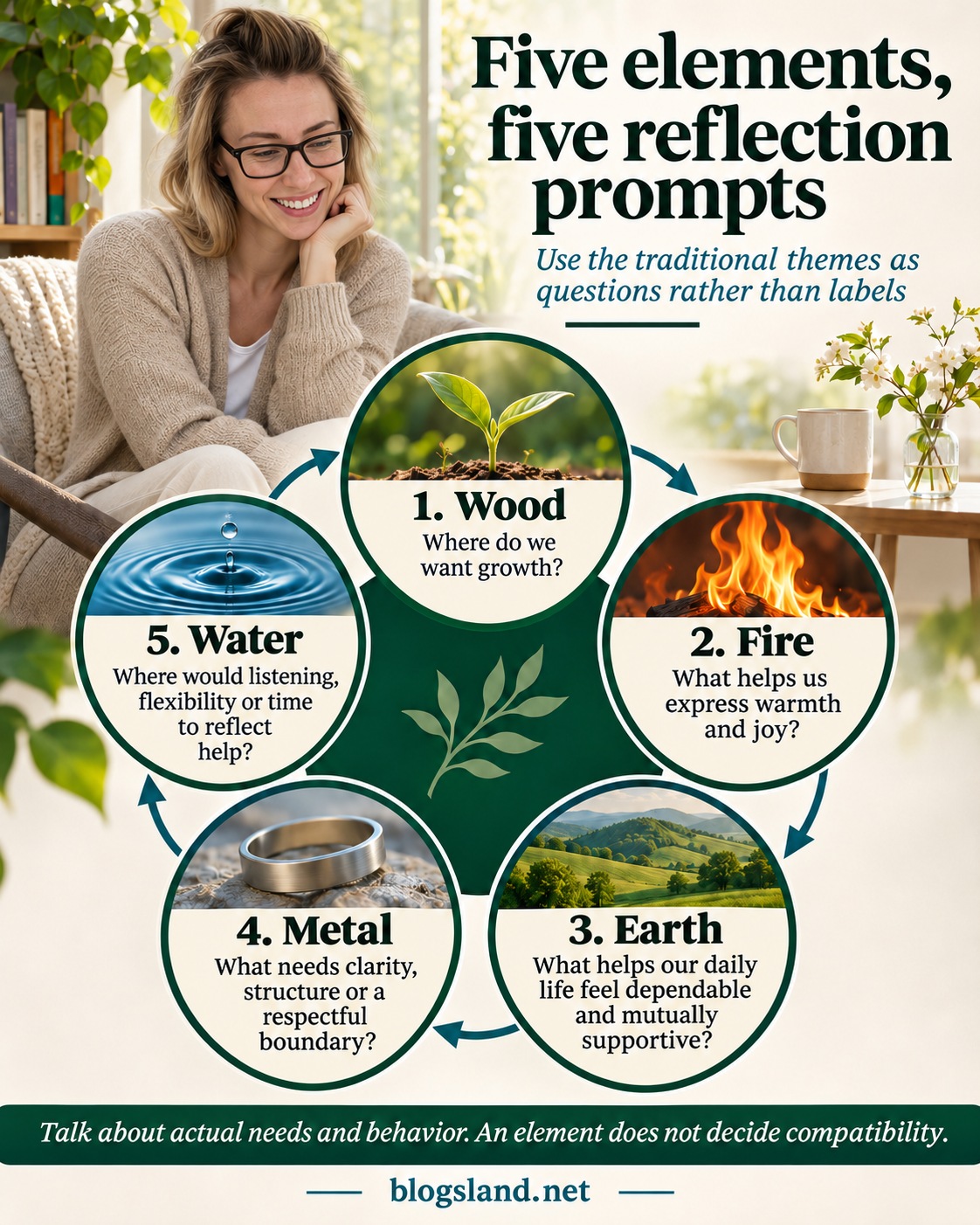
Read the visual guide as text
- Wood. Where do we want growth?
- Fire. What helps us express warmth and joy?
- Earth. What helps our daily life feel dependable and mutually supportive?
- Metal. What needs clarity, structure or a respectful boundary?
- Water. Where would listening, flexibility or time to reflect help?
Talk about actual needs and behavior. An element does not decide compatibility.
Earth: what makes daily life dependable?
Earth can stand for steadiness and practical care. Look at the ordinary work of a relationship: keeping arrangements, communicating changes and noticing needs.
Ask: “Which agreement would make this week easier?” A useful answer names who does what and when. “We should be more supportive” may become “You handle the appointment booking, and I will arrange transport.”
Metal: which boundary needs clearer words?
Metal can prompt reflection about definition and limits. Consider privacy, money, time, physical affection and responsibilities. A boundary should be understandable without requiring the other person to guess.
Try: “I’m happy to discuss this, but I cannot continue while we are shouting. I would like us to return to it this evening.” Adapt the timing and approach to your circumstances. Where there are threats or fear, seek individualized safety support rather than relying on a joint exercise.
Water: what have you not heard yet?
Water can suggest listening and allowing room for uncertainty. Ask an open question, listen to the answer and check what you understood: “It sounds as though the last-minute changes have been tiring. Is that right?”
Listening does not require agreeing with everything or accepting mistreatment. It means letting the person describe their experience before you decide what it means.
Use the images to make one small change
- Name one situation without an element label: “We keep changing weekend plans.”
- Choose the prompt that seems useful, such as Earth for clearer agreements.
- Make one specific request and hear the other person’s response.
- Agree on a manageable action if both people want it.
- Revisit whether the action helped, rather than whether you used the element correctly.
People may connect different meanings with the same image. There is no need to settle whose symbolism is right. Do not use an element label to excuse controlling behavior or decide someone is inherently unsuitable.
If spiritual reflection is meaningful to you, let it open a conversation. Judge the usefulness of the exercise by clearer understanding and considerate behavior in everyday life.