

The five elements can give you images for thinking about change, care, limits and relationships. Use those images to ask about a situation and check what the people involved actually experienced.
Give the five phases their context
Wuxing belongs to Chinese intellectual and cultural traditions. Wood, fire, earth, metal and water represent changing processes in many accounts. This article adapts their images as prompts about growth, expression, care, limits and reflection. The Internet Encyclopedia of Philosophy’s wuxing entry describes several uses and historical contexts.
Where the five phases come from
There are different traditions that use different elements and have different meanings. Wuxing refers to wood, fire, earth, metal, and water. There are other systems that shouldn’t be blended into this method without explaining the real differences.
According to the Internet Encyclopedia of Philosophy’s overview of wuxing it describes five phases or processes within Chinese thought. Its history and uses are broader than a short personality description.
This matters because just doing an easy online quiz might show one interpretation as if it were a full tradition. Ask where the interpretation comes from and what it claims it can do. You can like the imagery but acknowledge that one article or reading doesn’t mean it has historical use. Respecting the traditions includes being clear about the limits of your own changes.
Keep the image open to interpretation
But remember that the five elements can’t prove that someone is right or wrong for you, predict exactly how a relationship will turn out, or explain every part of your personality. Just because you connect with a particular element doesn’t mean that it determines your future or limits the decisions you can make.
The important thing is thinking about what you’re learning from the experience. If exploring the elements helps you understand your feelings or have a meaningful conversation with someone, you might find it useful. But if you find yourself trying to fit every experience into a certain category, it might be better to look at things differently. You can appreciate the meanings behind the elements without believing that every interpretation has to apply to your life.
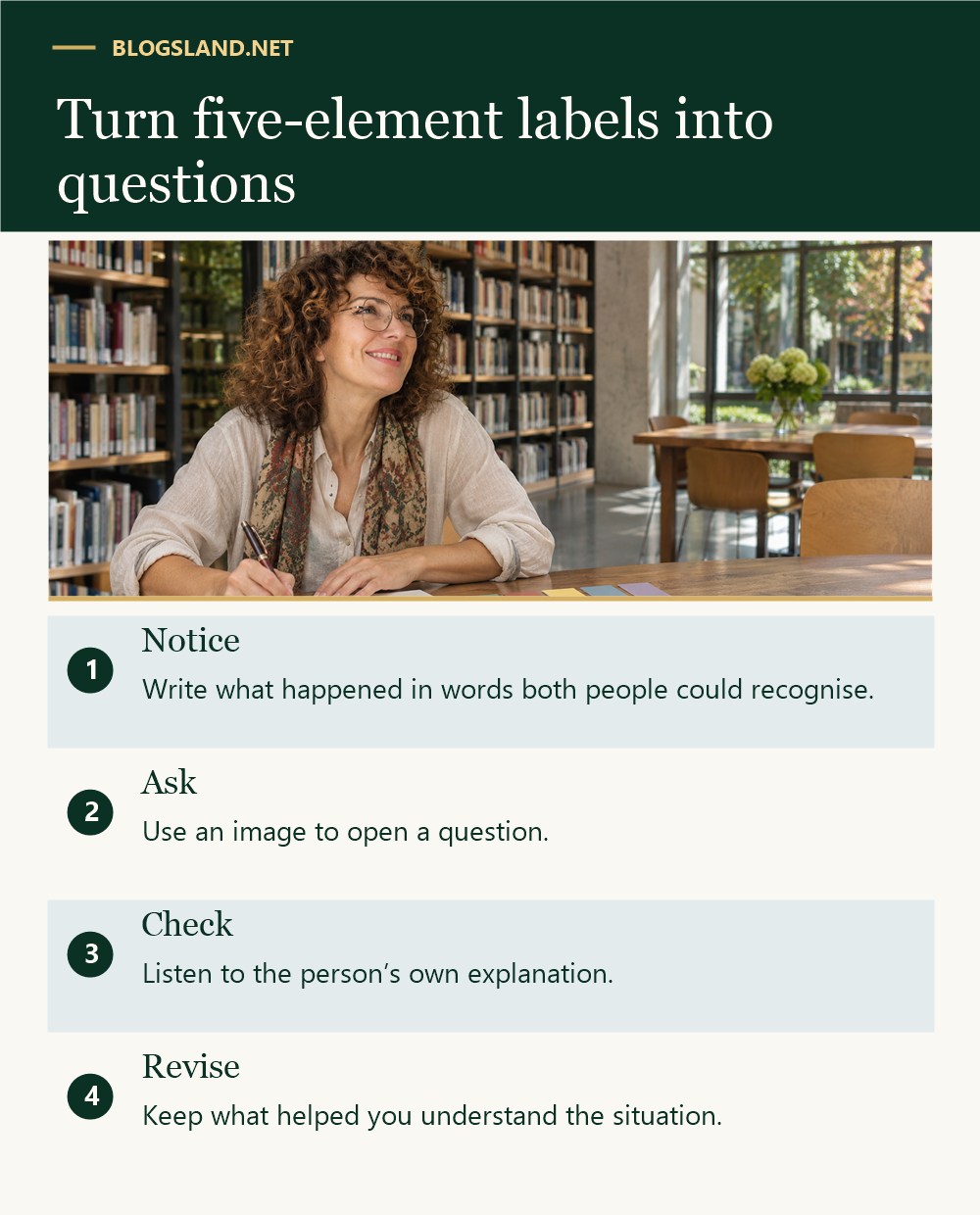
Read the visual guide as text
- Notice. Write what happened in words both people could recognise.
- Ask. Use an image to open a question.
- Check. Listen to the person’s own explanation.
- Revise. Keep what helped you understand the situation.
Use the images to ask better questions
Each of the five elements has traditional meanings that people might connect with different parts of their lives. For example, water is often associated with flexibility and reflection, while wood is connected with growth and development. You might find that some of these meanings remind you of your own experiences or the qualities you’d like to develop.
But connecting with an element doesn’t mean that you’re limited to the characteristics associated with it. For example, imagine that a woman named Natalie feels drawn to the meaning of water because she enjoys quiet time and thinking things through before making decisions. That doesn’t mean she always prefers being alone or that she can’t enjoy exciting activities with her friends.
Use first-person language
A fixed label can make having a conversation sound like it’s done before the other person has a chance to speak. You can say something like, “You are too much fire,” which might sound like you’re criticizing someone without talking about the behavior that has you upset. Try to make an observation when you speak to them, such as, “Our conversation moved too fast, and I wasn’t able to explain my point of view.” Then ask for a change, like slowing down during the conversation.
This allows the person to understand what you’re saying and respond to you. They can disagree, clarify what they mean, or help make a new plan. The symbol might be useful to you privately, but it doesn’t have to be part of a request. Giving a clear description respects your experience and the other person’s right to talk about what’s going on from their own point of view. It also makes improvement possible without requiring someone to change who they are.
Check which circumstances matter
A person who’s quiet in a group might be tired, unfamiliar with the setting, processing information, or just like listening. The behavior on its own doesn’t mean that you have a permanent personality type.
Ask what changes in the situation. Do they talk differently when they have close friends? Is the room noisy? Are they managing a barrier, like language or access to the conversation? Context can make a label less complete.
You don’t have to have a full explanation for everything they do. You need to allow there to be ordinary situations before you give everything a meaning. A good question might be, “What would make you more comfortable? Would a smaller group help?” This is something they can respond to. Calling someone an element might be insightful to you personally but leave them confused and the situation not changed.
Let other people describe themselves
If you’re exploring the five elements with someone else, it’s important to remember that they might not interpret the meanings the same way you do. Before discussing their personality or connecting them with a particular element, make sure they’re interested in having that kind of conversation. Some people enjoy exploring spiritual ideas, while others might not find them meaningful.
Think of a woman named Rebecca is talking with her friend Christina about the five elements. Rebecca connects Christina with the wood element because she believes that Christina is always interested in trying new things and making changes in her life. But Christina explains that although she enjoys learning new skills and exploring different ideas, she also likes having familiar routines and knowing what to expect when it comes to her family.
Instead of insisting that Christina must fit the description of wood, Rebecca could recognize that her friend’s experiences are more complicated than one spiritual interpretation. She might even discover that Christina enjoys change in some areas of her life but prefers stability in others.
Use relevant evidence for important decisions
The five elements can be interesting to explore when you’re thinking about your personality, relationships, or the things that matter to you. But it’s important to understand that their spiritual meanings can’t diagnose health conditions or tell you exactly what decisions you should make about your future.
If you’re experiencing unexplained physical symptoms or struggling with your mental health, you shouldn’t assume that the problem is connected to an imbalance in one of the elements. A spiritual reading might help you reflect on how you’re feeling, but it can’t determine what’s causing your symptoms or if you need treatment. Those concerns should be discussed with a qualified healthcare professional.
The same thing works when making major decisions involving your money, career, education, or legal responsibilities. You might feel connected to the earth element because you value stability and security, but that doesn’t mean the element can tell you which job to accept or if a financial agreement is right for you.
Try changing one thing you can choose
When you’re exploring the five elements, it can help you to think about something that recently happened in your life and how you responded to it. Instead of using an element to explain your entire personality, try focusing on one situation, what you needed at the time, and what you might do differently if something similar happens again.
Think of a woman named Jessica has been feeling frustrated because her coworkers frequently make last-minute changes to their schedules. She realizes that she has a difficult time adjusting when plans change unexpectedly because she likes knowing what to expect. Instead of deciding that she’s naturally inflexible because she connects with the earth element, she thinks about what would make those situations easier to manage.
Jessica decides that asking her supervisor for more advance notice about schedule changes might help. She can still appreciate the stability associated with the earth element, but she doesn’t have to believe that she’s incapable of handling change. The important thing is recognizing what she needs and finding a practical way to address it.
Related reading. Five Elements in Relationships: A Reflective Starting Guide.
Frequently asked questions
1. What are the five elements in wuxing?
Wood, fire, earth, metal and water are commonly translated as five phases or processes in Chinese philosophy. Their meanings depend on the tradition and context.
2. Can the five elements tell me someone’s personality?
Use the imagery to ask about a situation, and let people explain their own experiences and preferences.
3. Can I use more than one element to reflect on a situation?
Yes. A work discussion might suggest a question about boundaries and another about growth. Keep whichever question helps you understand the situation.
4. What can I say if someone uses a label I dislike?
Say how you see the situation and ask them to describe the specific behaviour they observed. You can decline a description that doesn’t fit.
5. Should a five-elements reading decide an important choice?
Use relevant information, consent and qualified advice for consequential decisions. If you enjoy the symbolism, keep it as one way to explore your questions.